 Audio
Audio 
Here is another device to help you locate your downed R/C sailplane in the bushes and weeds. Similar to the other design, this circuit plugs into a spare servo socket on your receiver, and it is a pulse omission detector. The alarm sounds when pulses originating from your transmitter are no longer being received--turn off your transmitter to turn on the alarm and help you find your plane. This circuit is simpler than the other design, is much easier to build, but is not quite as specific. While the other design tests for a specific frequency of pulses, this design is less picky, and may not work quite as well in areas with more radio frequency background noise. This design was originally collected from another web site, but the site has gone off-line and I'm unable to give proper credit to the individual. I modified the original design a little to make it work more reliably with the more aggressive automatic gain control of some of the current receivers.
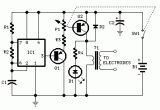
Circuit diagram

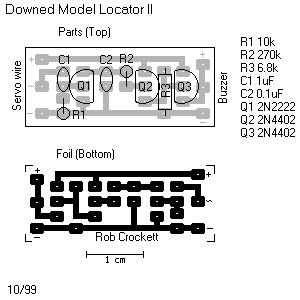
The circuit draws 1mA (!) when idle and 7 when buzzing. You can use a piezo buzzer right on the board (light and compact), a large piezo buzzer on a short wires (louder and easier to hear tone), or use the magnetic buzzer (a little heavier but good raspy sound). With the transmitter off, the alarm is mostly on, punctuated now and then by a servo wiggle and alarm silence from background radiofrequency noise pulses. This device is easy to build and works great. It's amazing how much your search time will be cut even with wind or surf noise in the background. Being able to hear it from 20 feet away often makes the difference between finding and not finding a plane.
If your plane went down because of radio interference, this device may not sound much. If you think it may have been interference from another pilot's transmitter on your frequency, be sure to have the other transmitter turned off before you go hunting for your plane.
The circuit uses your receiver battery for power. For the ultimate in reliability, you can use an additional battery to supply the alarm as follows. Connect only signal and negative leads to your receiver socket, and connect the second battery positive to positive circuit lead and negative to negative circuit lead. You will need to put some kind of switch in series with the second battery to keep it from running the alarm when you are not flying. With the extra battery, you will still be able to find your plane if your plane went down because of a receiver battery failure, or if your receiver battery fell out in the crash. Note: Do NOT solder to a button battery--they explode.
Here are few Radio Shack parts numbers. Please note that any type of capacitor will work (ceramic, electrolytic, etc.) but that the tantalum and monolithic capacitors are very small. The tantalum capacitors are polarized, but at these low voltages, the polarity probably does not matter.
Parts
273-074 board mount tiny 12 volt piezo buzzer, one per
273-065 larger and louder 12 volt piezo buzzer, one per
273-054 6 volt electromagnetic buzzer, one per
276-1617 2N2222-type NPN switching transistors (box of 15)
276-2023 2N4402-type PNP transistor (MPS2907), one per
272-109 0.1uF monolithic capacitors, five per
272-1434 1uF tantalum capacitor
271-312 1/4 watt resistor assortment, 100 pieces
Author: Rob Crockett 10/99
Email:
Website: http://www.electronics-lab.com